
The Hidden Cost of Purpose
Reflection from SECNA Board Member Jay Boolkin. Published 1 September 2026.
Purpose makes it very easy to run yourself into the ground
I've been in Australia's social enterprise sector for more than a decade, and I still remember when it clicked. A business whose whole reason for existing is to solve a social or environmental problem. Not a company that does a bit of good on the side, and not a charity kept alive by the next grant, but an actual trading business with purpose built into its core. At the time that felt like a genuinely new idea to me, and a thrilling one. I never really looked back after that.
For most of those years I ran Social Change Central, an online hub I co-founded with the wonderful Anne Lennon back in 2016 a one-stop place for Australian social enterprises to find funding, news, opportunities and support - from jobs and events to competitions, awards, tools and guides. We built and ran it together for ten years, and earlier this year the two of us decided it had run its course.
Closing it was harder than I expected, mostly because ten years is a long time to be attached to anything. I've never tied my identity to Social Change Central, but I'd poured a huge amount of myself into it, and that's not an easy thing to let go of. There's the practical side, the sudden gap where a decade of habit used to be. And underneath that, a quieter question about who you are without the work that's shaped so much of your days.
What made it sit better was looking at why the thing Social Change Central set out to do is less needed now than it was. When we launched, it was genuinely hard to get the lay of the land. Who was who, what was happening, where the opportunities were, how it all fit together. Social Change Central was there to help people make sense of that. A decade on, the sector's a lot easier to read. There are wonderful state peak bodies, connectors and ecosystem builders now, and a lot of them do the kind of navigating and signposting we used to do, and do it well. Walking away from something because it's less needed than it once was is about the best reason you can have.
The other reason is simpler. I've got three young kids who are the best thing in my life, and right now that's where I want my time and energy going. Between that and the sector being in good hands, I'm at peace with the decision.
Being at peace with it doesn't mean you're okay, though. I hadn't realised how much I'd been carrying until I set it down, and between that, the kids, and everything else, I was more worn out than I'd have admitted to anyone. I hadn't done any proper self-reflection in ages either. Way too long. I wanted a pause. Somewhere quiet enough to actually think, instead of in the ten-second gaps between everything else.
That's roughly the state I was in when I went to Reignite. I was closely involved in the early work that brought SECNA into being, so there was something quietly fitting about SECNA now being the one to support me. The organisation I'd helped get off the ground was giving me space to stop and think.
Reignite is a two-night retreat, held at Midginbil Eco Resort up in Northern NSW, on Bundjalung Country. The setting is gorgeous. You're surrounded by bush, properly tucked into the landscape, and it strikes the balance I love: wild enough to feel a long way from the city, but genuinely comfortable and cosy, with the organisers looking after every detail so you can actually switch off. Big shout out and immense gratitude to Tom Allen and Luke Faccini for putting it on year after year. And it's worth knowing why they started Reignite in the first place. They'd worked with thousands of purpose-driven founders and kept seeing the same pattern: people running near empty, close to burnout, stuck working in the business instead of on it, with no real space anywhere to stop and think. Reignite is their answer to that, and given where my head was at, it was exactly what I needed.
The whole thing is screens-down. No phones, no cameras, no tech. I assumed I'd struggle with that part. But I loved it. It was easier than I thought it would be, and once the noise was gone and I was somewhere that quiet with nothing pulling at my attention, the reflection actually had somewhere to go.
One of the highlights for me was an exercise Al Jeffery ran called the Wheel of Life. If you haven't come across it, the basic idea is simple. You take the main areas of your life - things like health, relationships, work, finances, fun, personal growth - and rate how you're actually doing in each one. Plotted around a circle, those scores form a shape, and the shape tells you something at a glance: where things are full, where they're running low, how lopsided the whole picture has become. It sounds almost too simple to matter. It isn't.
I want to be honest about how good Al is at this, because it's the reason it works. He holds the room with real care, he asks the questions most of us are quietly steering around, and he somehow makes it feel safe to sit with an answer you'd rather not have. I won't give his particular method away, but the short version is that it's a structured, honest way of seeing where each part of your life actually stands. I'd done the Wheel exercise once before, so this time I knew what was coming, and that's exactly why I was nervous. I already had a rough sense of how I'd been feeling, and I wasn't sure I wanted to see it laid out in front of me. Working through it was slow and absorbing, and I approached some parts warily. By the end it had been confronting, but genuinely worth it.
A few things came up that I've been chewing on since.
The first is just how rarely I stop to take stock. There's a particular jolt in realising you haven't checked in on yourself in what feels like years. The exercise didn't hand me anything I didn't already have. It just took away my ability to keep not-looking at it. Reflection doesn't invent your problems. It takes away the option of pretending they aren't sitting there.
The second will be familiar to anyone working in social enterprise. Or the for-purpose space. Or the impact economy. Or the changemaker space. Or whatever we're calling it this week. Purpose is a very respectable cover story for running yourself into the ground. "The work matters too much for me to stop" is basically unchallengeable. And a cause isn't like a job where the shift ends and you go home. There's no natural finish line. It will happily take everything you'll give it and then look at you expectantly for more.
Burnout doesn't announce itself. It creeps in so slowly that each new level of tiredness quietly becomes your new normal, and you can't remember what rested felt like. That's the whole point of a structured check-in. It surfaces what ordinary days can't, because ordinary days are exactly what let it blend in. Sitting with the Wheel, I could see a few of those signs starting to show for me, enough to take seriously. It also made something plain that I'd never quite put into words. Being good at the mission and being good at looking after the person delivering it are two different skills, and I'm a lot better at the first.
Al said it better and more sharply than I could:
"Often those of us in changemaker or caretaking spaces find it easy to exclude ourselves from the ways in which we are caring so powerfully for the world around us. Looking at burnout rates, and the increasing mental health crisis within the sector, it seems only necessary that we start to see our internal systems as interdependent with the very systems so desperately in need of care."
The last thing I came away with is that this kind of reflection is a habit, not a single event. One snapshot doesn't tell you much on its own. It's the comparison over time that's useful. That's a big part of why I went back and found the Wheel I’d completed a bit more than a year previously, and why my wheel is now stuck to the wall of my home office where I have to look at it. It's an uncomfortable reminder of the parts of my life I've been meaning to pay attention to. It hasn't fixed anything. I don't think it's supposed to. What it did was smaller and more useful than a fix. It made it easier to see where I actually am and to be honest with myself about how I'm doing.
If you work in or around social enterprise you'll know the pull I'm talking about, the way the mission quietly elbows the person aside. I'm not here to tell anyone how to look after themselves. I'm just telling you what worked for me, in case it's of any use to you. The Wheel of Life itself isn't some secret. If you search for it you'll find any number of versions and templates, and if you want to sit down and try the basic exercise yourself, that's a decent place to start. What I'd gently say is that a lot of the value for me wasn't in the diagram. It was in being somewhere screens-down with someone who actually knew how to hold the process. So if it strikes a chord, have a go at the exercise, but also go and look at what Al does. I can't recommend him enough. You'll find him at aljeffery.com, along with Turning Ground and Bloom Journals.
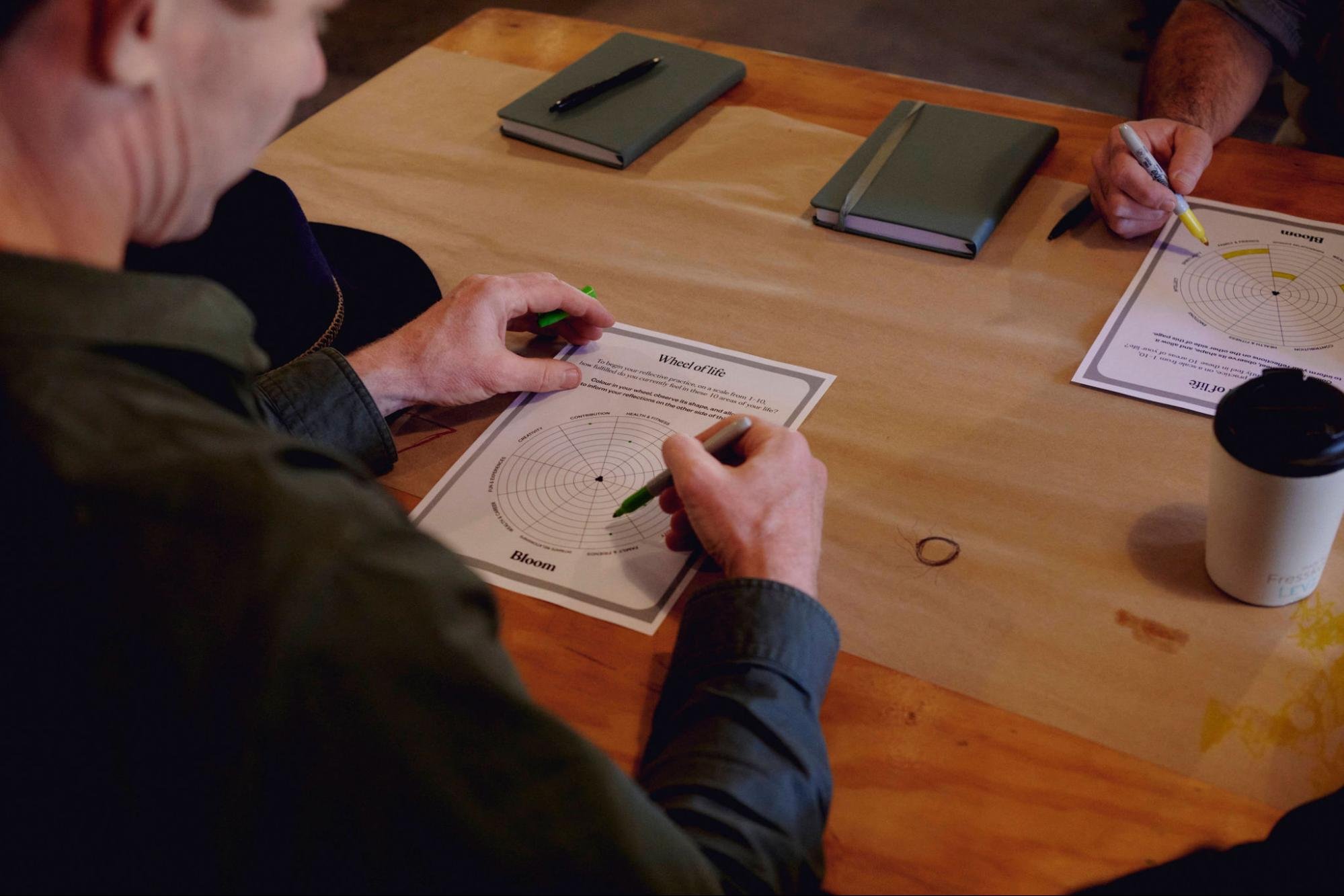
Photo by Olivia Katz