
What Rural India Can Teach Us About Women-Led Enterprise
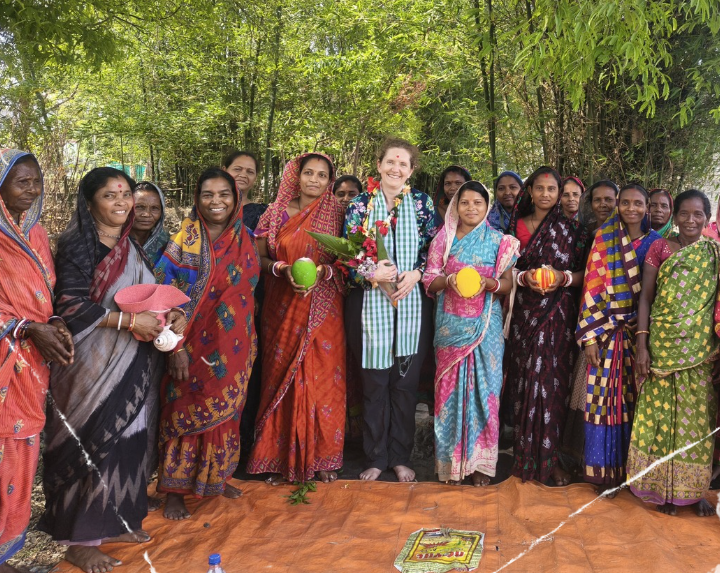
What happens when we look beyond individual entrepreneurship and ask a bigger, bolder question: What if the real key to thriving rural communities is collective power?
Recently, Rebel Black (one of our Social Enterprise Champions and also an advocate for cooperatives and Co-founder/Chairperson of THE Rural Woman Cooperative) embarked on a learning exchange study tour across India. Traveling from remote hill communities in Odisha to bustling cooperative networks in Mumbai, Ahmedabad, and Kerala, Rebel set out to observe women-led cooperative, collective, and social enterprise models operating at scale.
The economic, social, and cultural contexts of India and Australia are vastly different, but Rebel was keen to observe deeply, listen carefully, and draw out core principles that could transform how we support rural Australian women.
Here is a glimpse into what she discovered and why it matters for the future of regional Australia.
1. Economic Participation is About Voice, Not Just Income
Across every region Rebel visited, one truth echoed above all others: when women build economic agency, money is only the starting point.
In the remote hill communities around Bangriposi in Odisha, women participating in the Social Capital Credits (SoCCs) program shared how they once hid in their homes and locked their doors when visitors arrived. Less than two years later, those same women gathered proudly to share their goat-rearing enterprises, showcasing how their newfound confidence shifted their influence within family decision-making and sparked new aspirations for their children.
Economic participation provides:
Voice and Dignity: Moving from isolation to collective confidence.
Household Influence: A seat at the table when making family and financial decisions.
Community Resilience: A shared safety net that helps families withstand economic shocks.
2. Power to the Coalface: Reimagining Ownership and Movement
In Mumbai, the famous Lijjat Cooperative proved the potential of decentralised, women-owned enterprises. What started with seven women and a small loan is now a decades-old national enterprise with tens of thousands of members. Its defining principle? The women making the product (the papad rollers and dough makers) are the sole owners. The managers are employees; the workers own the enterprise.
Further south in Ahmedabad and Kerala, SEWA (Self Employed Women’s Association) demonstrated the power of long-term "movement infrastructure." SEWA is far more than a program provider—it is a union, a cooperative ecosystem, an advocate, and a source of social protection. In Kerala, women spoke of how the collective mobilises when a member faces mistreatment at work or harm at home. The sisterhood extends far beyond the workplace.
3. Embracing the Realities: Living Systems, Not Fairy Tales
The study tour didn't shy away from complex realities. Women-led cooperatives are not idealised, conflict-free alternatives to mainstream economics. They are living, adaptive, and deeply human systems.
The report highlights real tensions that must be navigated thoughtfully:
Aspiration vs. Pressure: Rapid economic growth can bring unexpected burdens.
Scale vs. Sustainability: Scaling up can introduce ecological and market risks.
Distortion of Models: Financial systems can sometimes exploit collective trust (such as bank-led debt structures skewing self-help groups).
Internal Dynamics: Cooperatives must actively manage internal hierarchy, conflict, and uneven participation.
Understanding these tensions allows us to design better, stronger, and more human-centered systems at home.
The Strategic Question for Rural Australia
While the context in regional Australia differs, the underlying pressures rural women face are strikingly familiar: geographic isolation, underemployment, fragmented support, limited market access, and heavy caring responsibilities.
The insights from India challenge us to ask:
"What would become possible if women were supported through stronger collective systems of enterprise, leadership, mutual support, and community wealth-building?"
Rather than relying solely on individual entrepreneurship programs, the next phase of women’s economic development in rural Australia requires collective economic infrastructure.
What’s Next? Translating Insights into Action
The recommendations arising from this exchange focus on adaptation, not replication. Key priorities for THE Rural Woman Cooperative, SECNA, BCCM, and other sector partners include:
Piloting Rural Women’s Enterprise Circles: Creating structured local networks for peer-led growth.
Cooperative Shared Services: Exploring shared models to reduce overhead and isolation for regional entrepreneurs.
Backbone Support: Positioning THE Rural Woman Cooperative as a key backbone organization for regional economic participation.
Reciprocal Learning: Expanding knowledge-sharing and exploring ongoing partnerships with Indian social enterprises.
Women-led cooperative systems do not simply generate income. At their best, they create voice, belonging, leadership, and long-term community resilience.
Read the Full Report
For a deep dive into Rebel’s case studies, strategic frameworks, and policy recommendations:
